What to Expect When You Get a Hearing Test and Hearing Aid Fitting in Cape May Court House
If you have never seen a hearing care provider before, the biggest surprise is usually how straightforward the process is. A full hearing evaluation in Cape May Court House takes roughly one hour, involves no needles or discomfort, and — because the evaluation, results conversation, and prescription selection all happen at the same local practice — you never need a referral or a trip to a second facility. Fall is a natural time to take this step: many people first notice how much they are missing when the volume of a holiday dinner table reveals the gap.
What Should You Do Before Your First Appointment?
No referral is required — you can book directly and walk in ready to go. Bring a list of any medications you take and, if someone close to you has noticed changes in your hearing, a quick note of their observations can be surprisingly useful data for the provider.
Check-in is straightforward. You will fill out a short health history that covers ear infections, noise exposure, and any family history of hearing loss. This context helps the audiologist interpret your results accurately rather than looking at numbers alone.
How Does the Hearing Evaluation Actually Work?
Pure-tone audiometry and speech testing together form the core of the exam — both are non-invasive, take 30 to 60 minutes combined, and require nothing from you except honest responses to what you hear.
Pure-tone audiometry means you sit in a quiet booth wearing headphones while tones at different pitches and volumes are played one ear at a time. You signal — usually by pressing a button — each time you hear a sound. There are no right or wrong answers; the point is simply to find the softest level at which you can detect each frequency. Those threshold points are plotted on an audiogram , which is a graph showing how well each ear hears across the range of pitches that matter most for speech.
Speech testing follows the same logic but uses recorded words instead of tones. The provider measures how well you understand spoken language at different volumes, which captures something pure-tone results alone cannot: how clearly your brain processes what your ears detect. Difficulty with speech clarity — especially in noise — often explains why a person turns the TV up but still feels like they are missing words.
Understanding Your Results on the Same Visit
Once testing is done, the audiologist walks you through the audiogram in plain language, explaining both the degree of hearing loss — mild, moderate, severe, or profound — and which frequencies are most affected. Understanding your degree of hearing loss matters because the pattern determines everything about how a hearing aid should be programmed.
This conversation connects test data to real-life situations. A loss concentrated in the higher frequencies, for example, typically makes consonants like 's' and 'f' hard to distinguish — which is why speech sounds muffled even when it seems loud enough. Knowing the shape of your audiogram explains experiences you may have been puzzling over for years.
Choosing Prescription Hearing Aids That Match Your Audiogram
A prescription hearing aid is programmed specifically to your audiogram — it is not the same as an over-the-counter amplifier, which simply makes everything louder without accounting for which frequencies you actually need boosted. Selecting the right device involves your degree of loss, your daily lifestyle, your ear canal anatomy, and your budget.
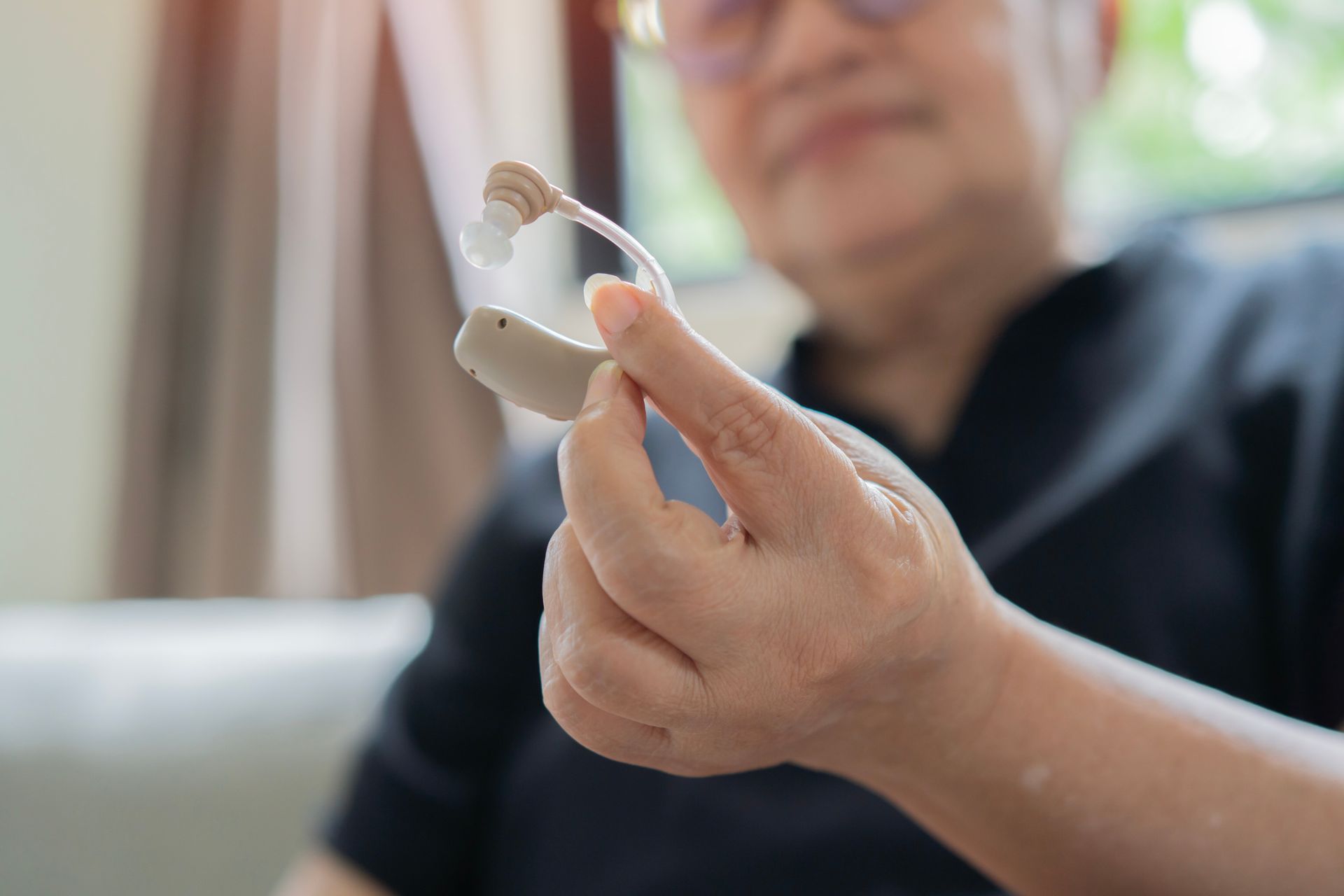
The practice carries prescription hearing aids and fittings, including Oticon devices, which are known for their layered sound processing. Device selection may happen at the evaluation appointment or at a short follow-up visit, depending on what is needed. If your chosen aids are not in stock, they are ordered and a fitting appointment is scheduled once they arrive.
What Does a Hearing Aid Fitting Actually Involve?
'Fitting' means more than placing a device in your ear. The audiologist confirms the physical fit, then loads your audiogram data directly into the hearing aids so the amplification at each frequency matches your specific prescription. Real-ear measurements — where a tiny probe microphone sits in the ear canal while the aid plays sound — can verify that what the device delivers matches what your ear actually needs.
You will hear with the aids for the first time right there in the office. The sound will feel different rather than simply louder, because the aid is selectively amplifying frequencies you have been missing. Feedback from you during this appointment drives immediate fine-tuning of volume, programs, and balance between ears. For details on the fitting and repair services available locally, see the Oticon hearing aid service and fittings page.
Before you leave, you get practical guidance on what the first days and weeks of wearing feel like. An adjustment period is normal — your brain needs time to relearn sounds it has not processed clearly in a while, and that recalibration happens gradually.
New Jersey Winters and the Case for Acting Before the Holidays
Cape May County's social season peaks around Thanksgiving and the December holidays, when large family gatherings put real demands on hearing. Scheduling your evaluation in the fall means you have time for both the fitting and an initial follow-up adjustment before those gatherings arrive — rather than realizing mid-December that you missed most of the conversation at the dinner table.
New Jersey also does not require a physician referral to see a licensed hearing aid dispenser, so there is no waiting period for a doctor's order before you can book.
How Many Appointments Should You Plan For?
Most patients complete the process in two to three appointments: the evaluation and results conversation, the fitting, and at least one follow-up in the first few weeks to refine programming based on real-world experience. In some cases — if devices are in stock and the selection is straightforward — the timeline compresses. Follow-up adjustments are the norm, not a sign that something went wrong; fine-tuning after real-world use produces better long-term outcomes than a single session ever could.
The full journey from evaluation to well-fitted hearing aids is more manageable than most first-time patients expect — one local practice, a clear sequence of steps, and a provider who explains each result before moving to the next stage.
When you are ready to take the first step, schedule a hearing evaluation with Cape May County Hearing Aid Dispensary and start the process on your own timeline.